The Founder · Raghav R Handa
The lawyer who builds the software.
One person sits behind every adnah build, and that has not changed as the studio has grown. He has held a bar card in three jurisdictions, taken a legal-tech product past a hundred thousand users, and then spent the better part of a decade writing the code himself instead of handing that part to someone else. A matter gets read the way a lawyer reads a brief; the fix gets shipped the way a builder ships a release.
None of that is classroom knowledge. It was assembled inside other people's stuck processes - an inbox nobody had emptied, a spreadsheet standing in for a database, a deadline tracked from memory - by staying with the mess long enough to see its actual shape. Every engagement adnah runs still opens the same way.

- Bars
- India · UAE · Singapore
- Published in
- Livemint · Bar & Bench · LegalEra
- Products shipped
- MatterOS · LexOS · ShouldISignAI
- Doctrine
- The MATTER Method
9+
Years building systems
200+
Systems delivered
25+
Countries served
100k+
Lawyers reached at scale
The story
Three things at once. None of them dropped.
Lawyer, founder, builder - fully, and at the same time. Most legal technology fails because it is built by people who have only ever been one of the three.
01
Where the reasoning comes from
Courtroom logic, not classroom theory
Before any of this was software, it was a working docket. Courtrooms in India, the UAE and Singapore taught a specific discipline: facts have to hold up, obligations have to be traceable, and consequence is never hypothetical. That habit of mind sits underneath every build - it is the reason his systems keep working once real, regulated stakes are attached to them.
02
What the scale years proved
A hundred thousand users was the rehearsal
Taking a legal-tech product to more than a hundred thousand lawyers inside a year, then consulting for US firms and running an AI venture out of Dubai, was the proof of concept for everything that came after. It showed him exactly where legal operations snap when growth outpaces process - the failure pattern adnah now exists to catch before it happens.
03
What nine years of building taught him
Two hundred systems, one habit
Nine years as an independent builder, starting in no-code because that was what a founder with no budget could actually ship, through every wave of tooling since, to agentic AI today. Two hundred-plus systems later, across legal operators and large enterprises alike, the habit never changed: understand the file first, build second. adnah runs that same habit as a studio.

Nine years in, still building the thing himself.
The path, from the courtroom to the codebase
- LawPractised in the courts of India, the UAE and Singapore
- ScaleGrew a legal-tech company to 100,000+ Indian lawyers
- SoloIndependent legal-technology consultant to US firms
- DubaiAI and business consulting venture
- No-codeBegan building systems for anyone who needed one
- LexOSLaunched the legal operating system on Notion
- MatterOSBuilt agentic case management for the small firm
- adnahOpened the studio that runs the same discipline as an engagement
- NowCustom AI systems for firms, corporates and government
Builder at heart
The build is the fast part. Understanding the file is the work.
The first stretch of any engagement is deliberately slow: paper, not code. Every handoff, every deadline, every point where the record quietly breaks gets named before a single line gets written. In his experience almost no organisation has actually written its own process down, and that gap - not a missing tool - is usually the real reason software stalls once it is installed.
Only once that map exists does building start, and it happens in public, with the client watching progress weekly rather than waiting for a reveal. A system nobody opens is dead weight regardless of how it was built, so the work does not end at deployment - it ends when the tool has become the easiest way to do the job. Until the numbers move, he does not call it finished.
Capabilities honed over nine years
- System design
- Process mapping
- AI agents
- Agentic workflows
- Document automation
- Data modelling
- Full-stack builds
- No-code & low-code
- Notion architecture
- Legal operations
- Product strategy
- Change management
- Client portals & intake systems
Delivered into
India · United Arab Emirates · Singapore · United Kingdom · Australia · Israel · Russia · Sri Lanka · Germany · Netherlands · United States - Texas, New York and California especially.
What he believes
Six beliefs, each one visible in how the studio runs.
- 01
AI is a tool, not a threat.
If you learn it properly. The lawyers who use it well will replace the ones who do not - the tool itself replaces nobody.
- 02
Systems make great professionals.
Not just hard work. A practice that runs on memory and habit is one sick day away from chaos, however talented its people.
- 03
Name the process before you buy the software.
Automation applied to an unnamed process only makes the mess faster. The sequence is fixed, and it starts with honesty.
- 04
Nothing real comes from passion alone.
Only years of work. The method was not read in a book; it was accumulated inside other people's half-finished processes.
- 05
No pilots for people who cannot say yes.
A demo for a committee is not a project. He builds for a named owner who can decide, not a process designed to avoid one.
- 06
You own what gets built.
Your repository, your database, your keys. No lock-in, no per-seat tax on your own system - on any engagement, ever.
Working together
What it is actually like.
- 01You talk to the person building it, start to finish. There is no account manager between you.
- 02The process gets written down before anything gets built.
- 03You own everything the engagement leaves behind.
- 04If the honest answer is that you do not need a build, he will say so.
He also runs a specialist litigation technology and expert testimony practice - digital evidence structured to survive court. It now runs through the studio: see litigation technology.
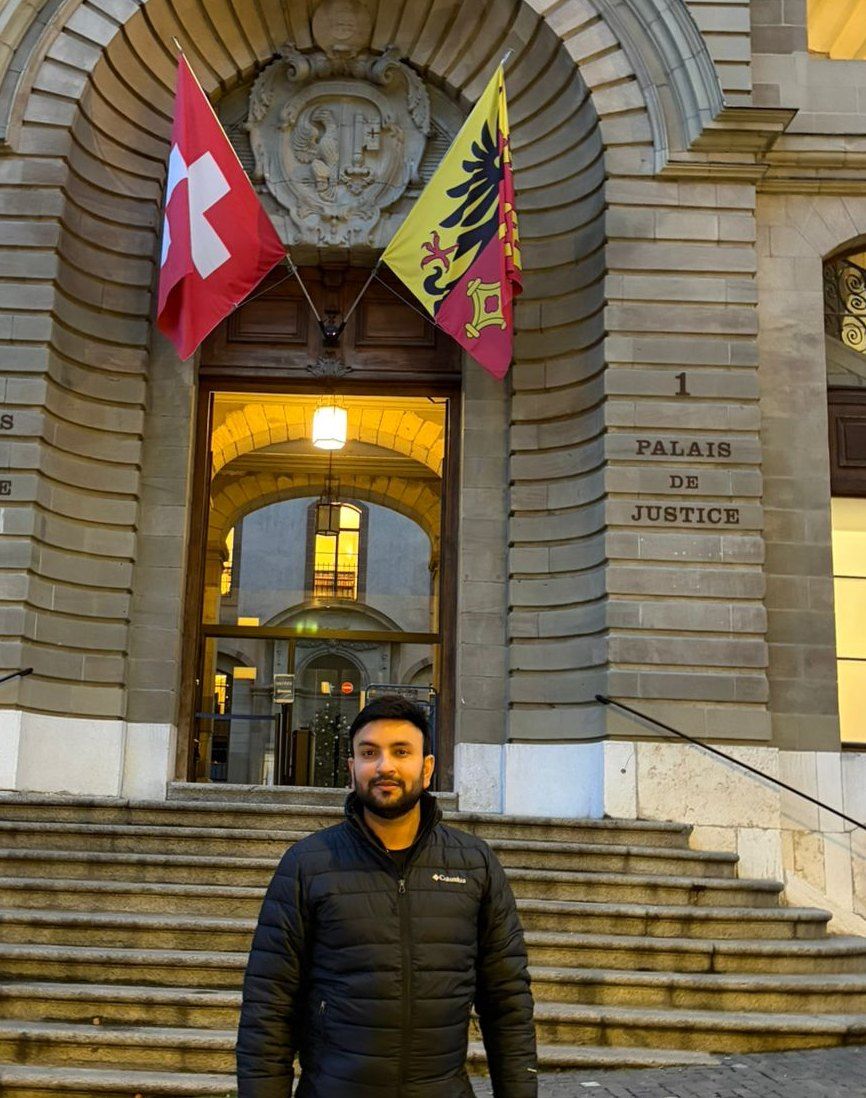
At the Palais de Justice in Geneva. Old courthouses, long walks, and an unreasonable amount of gelato - the rest of the file, off the record.
Where the authority above turns into work